AI Term of the Moment
accelerated computing
Definition: weights and biases
A neural network is a "math machine" that learns from examples. It comprises multiple layers of computational units called "nodes" or "neurons" that are mathematically connected to each other with numerical values called weights and biases, collectively known as "parameters."
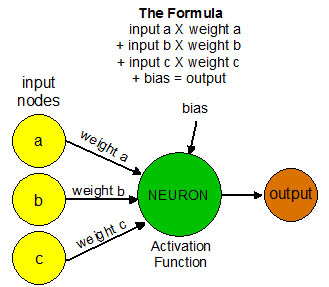
Weights and Biases
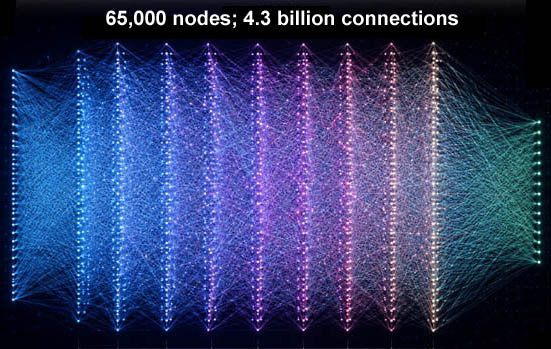
More Parameters than Neurons

Neurons are computational units, not fixed hardware. Weights control the strength of the connections, and the bias adds a fixed value to the neuron. The activation function is a formula that uses weights and biases to compute the strength of the neuron's output, which goes to every neuron in the next layer. Randomly set at the start, weights are constantly adjusted in the training phase. Bias values initially set to zero are adjusted to reduce errors. See backpropagation.
There are orders of magnitude more parameters than nodes/neurons. For example, two adjacent layers each with a thousand neurons have a million (1,000 x 1,000) weights plus 1,000 biases. This example has 65,000 neurons between input and output layers for more than four billion connections/parameters. In 2026, xAI's Grok 5 model is said to have at least six trillion parameters (see Grok AI). (Example generated by ChatGPT.)